Xh7c Pc8b Accessdomain Content Uploads 2018 Compensation Report Sorted 2017 Actual Pay
In 2022, organizations are worried quite a lot about attracting and retaining talent. With COVID-19 however raging, labor shortages are impacting production and inflation has surged. In December of 2021, inflation was 7 percent higher compared to a year ago — a twoscore-year high — which worsened to 7.5 percent in January 2022.
Adjusted for aggrandizement, the existent value of wages has been on a steady turn down for the improve part of a year. Only let's be honest: Wages were dissatisfactory earlier that and information technology's not the simply aspect of the employment experience that has driven people to rethink what they desire out of life. Workers are seeking better opportunities. At outset, this was called the Great Resignation, then the Swell Reshuffle, but in truth, it's both. It's a Swell Reevaluation. People want meliorate.
Expectations take changed. Workers want more than satisfying employment experiences and careers.
Compensation has an of import role to play here. Employers are scrambling for the salary data they need to figure out what to offer new hires, what to do for pay increases to retain the current workforce, how to provide meliorate benefits that business relationship for both physical and mental health, and how to accommodate workplace flexibility and remote work.
Basically, the employee experience has never been more important. Employees don't but desire to trade their time for coin anymore, especially wages that are dropping in real value month over month. They want to be meaningfully incentivized for their labor. They want career satisfaction.
Fortunately, Payscale can help. Our compensation best practices survey is the largest survey of its kind to assist employers understand how their peers are tackling these challenges.
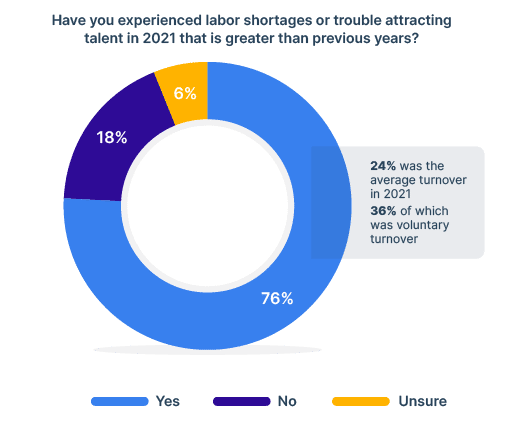
Despite unemployment beingness high in 2021 compared to contempo years, 76 percent of organizations say they experienced labor shortages or difficulty attracting talent in 2021. Our full study includes data insights on labor challenges, including breakdown of the data by company size and industry likewise as assay on what organizations are doing to attract and retain workers and ameliorate the employee experience.
Acme level findings in the full report include:
- 76% of organizations have experienced labor shortages or difficulty attracting talent in 2021.
- 24% was the average turnover in 2021; 36 percent of which was voluntary turnover.
- 49% of organizations say that voluntary turnover has increased compared to previous years.
- 75% of organizations are not looking to supercede workers with automation to solve shortages.
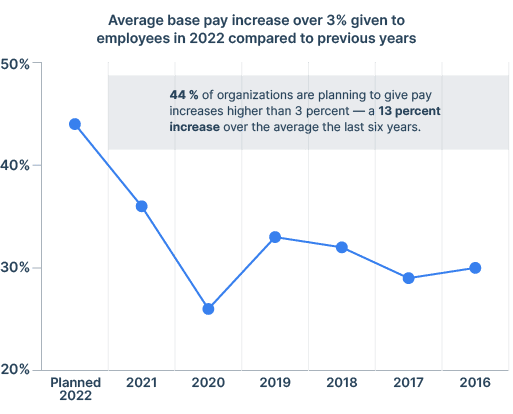
Pay increases are a disquisitional issue for employers this twelvemonth. Nosotros are seeing a dramatic increase in the percentage of organizations (92 percent) participating in giving pay increases in 2022, up from 85 percentage in 2021 and 67 percent during COVID-19 in 2020. The amount that base of operations pay will increase is also looking to rise compared to previous years. Nonetheless, it may not exist enough to gainsay inflation.
More insights related to pay increases are in the full report only include:
- 92% of orgs are giving base of operations pay increases in 2022.
- 44% of orgs are planning to give pay increases higher than three percentage — a 13 per centum increase over the boilerplate the last six years.
- 33% of orgs that cut or froze pay in 2020 did not make upwards for it and don't plan to.
- 44% of orgs say that pay is the reason they are losing talent.
- 85% of orgs are worried about aggrandizement but only 29 per centum increased their budget.
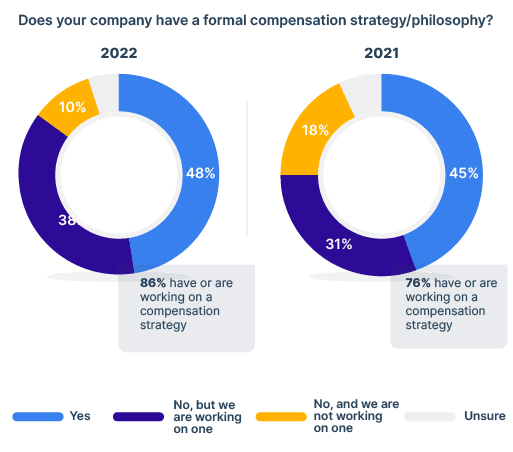
In 2022, the pct of organizations maxim they either have a compensation strategy or are working on one increased by x per centum to 86 percent. Yet, just 53 percentage of organizations are adequately confident or very confident in the effectiveness of their total reward package to concenter and retain talent.
The full report has more findings, including:
- 86% of orgs say they accept a compensation strategy or are working on ane — a 10 percent increases from last year and a 16 percent increment from previous years.
- 53% of orgs are fairly confident or very confident in their total rewards package.
- 75% of orgs look compensation will be more challenging in 2022 and lxxpercent plan to invest more in compensation management.
- Benefits that accept increased the near between 2021 and 2022 include remote work (25% increase to 65% overall), a work-from-home stipend (8.3% increase to 15% overall), flextime (7.seven% increase to 37% overall), and having a mental wellness or wellness program (7% increase to 66% overall). Another benefit to increase slightly merely notably is the 4-day work week (3.two% increase to 11% overall).
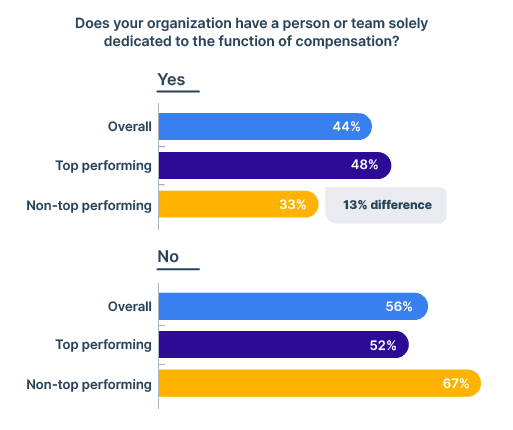
One of the biggest differentiators betwixt top performing organizations and non-top performing organizations is the presence of a person or team dedication to bounty. Although simply 44 percent accept a person or team in a function dedicated to compensation, the percentage is higher for meridian performing organizations (48 percentage) than not-top performing organizations (33 percent).
The full report provides boosted insights on bounty teams and overall maturity level, including:
- 44% of organizations have a person or team solely dedicated to compensation.
- 31% of organizations are currently a 3 or 4 out of 4 on the compensation maturity model (out of four), advancing or optimizing their pay practices.
- 41% of Payscale customers are more than probable to be advancing or optimizing their pay practices compared to 23 percent of non-Payscale customers.

Ii thirds of respondents reported that pay equity is a planned or electric current initiative at their organisation. This is a xx per centum increase compared to 2021. Equally in previous years, nosotros also see a clear divergence in delivery to pay equity assay between elevation performing organizations (67 percentage) and non-peak performing ones (58 percent).
The full written report has more than findings related to pay equity, including:
- 66% of organizations say pay equity analysis is a planned initiative in 2022.
- 52% of orgs program to do pay disinterestedness assay in 2022 — the get-go yr it'due south been a majority.
- 36% of orgs know what their system'south gender pay gap.
- 29% of orgs know their racial pay gap.
- 38% of orgs are doing something to address their pay gaps.
- nine% of organizations not doing pay equity analysis say it's considering leadership believes pay gaps are nonsense.
Fewer organizations are worried about remote piece of work changing the competitive landscape for attracting and retaining talent now compared to six months ago, likely due to the prevalence of companies opting for traditional or hybrid work environments (75 percent), which will mean that organizations will nevertheless be competing for talent locally.
The total report has more findings related to remote piece of work, including:
- 85% of orgs hold or strongly agree that workplace flexibility is a central driver of employee engagement — 12 percent higher than compensation.
- 47% of orgs limited business that remote piece of work will disrupt the competitive landscape.
- 74% of orgs say that remote piece of work is not a driving factor for adjusting their compensation strategy and structures.
- 42% of orgs have a pay strategy for remote workers or are working on it (18% currently have a strategy currently).
- 40% of orgs are interested in using geographic differentials for location-based pay.

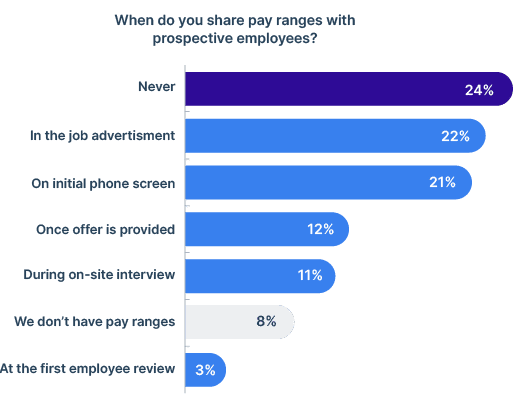
Most organizations want to take more pay transparency simply are hesitant to share their pay practices. However, it's important to be able to communicate pay decisions finer with candidates and employees. Washed correctly, pay communications can foster trust and appointment within a company. If washed poorly, retention and company culture may endure.
The total written report has more findings related to pay communications, including:
- 68% of organizations share pay ranges with employees but only 22 percentage do so in the job ad.
- xl% of organizations provide a total rewards statement to employees.
- 54% do non train their managers on how to accept conversations nigh pay with employees.
- 60% of organizations want to be at to the lowest degree a 3 on the pay transparency spectrum but only 36 percent evaluate themselves as such.
Top-performing organizations are defined as those who exceeded their revenue goals in 2021. In this year's study, a quarter of respondents (25 percent) fit this criterion.
We defined five organizational sizes for comparison as follows: Pocket-sized (1-99 employees), Mid-Size (100-749 employees), Large (750-iv,999 employees), Enterprise (5,000-49,999 employees), and Large Enterprise (50,000 or more employees). Nigh 35 percentage of respondents reverberate small organizations; 31 percent of respondents come from mid-sized organizations; 17 per centum of respondents come from large organizations; 12 per centum come from enterprise organizations and v percent from large enterprise organizations.
Our report provides response data for organizations in 15 industries. As in prior years, the top industries represented in the survey were Technology (including software), Healthcare and Social Assistance, Manufacturing, Finance & Insurance, and Nonprofits.
Respondents spanned the earth, including 4,225 respondents in the United States and 532 respondents in Canada. While organizations with both single and multiple locations were represented, a bulk of organizations surveyed reported a presence in multiple geographic locations.
A majority of respondents identified equally Manager or above (74 percent). A quarter of respondents identified their job level equally Private Contributors (26 percent).
Our respondents play a diversity of roles in the compensation process, including: reviewing and making pay increase recommendations (66 and 64 percent, respectively), completing comp market studies (62 percent), job evaluation (61 percent), updating comp structures (61 pct), setting new rent pay (52 pct), administering incentive and bonus plans for their system (45 percent), setting comp upkeep (33 percent), and much more.
Payscale's 2022 Bounty Best Practices Report is an 60+ folio analysis of compensation trends and charts taken from our survey of over 5,000 compensation professionals, HR leaders, and business organization executives. Roofing everything from base pay increases to compensation strategy, pay disinterestedness, and pay communications, this report offers unique insights on the state of the labor market and what other organizations are doing in terms of compensation and total rewards to attract and retain talent.
Source: https://www.payscale.com/research-and-insights/cbpr/
0 Response to "Xh7c Pc8b Accessdomain Content Uploads 2018 Compensation Report Sorted 2017 Actual Pay"
Enregistrer un commentaire